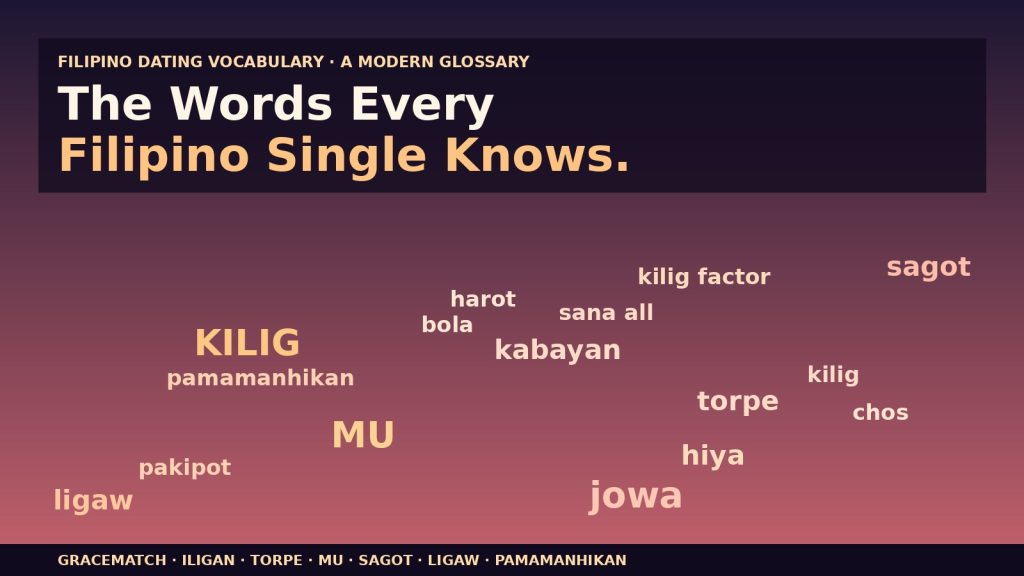
You cannot properly date a Filipino without knowing the words. Not just the English words for dating — the Filipino words. The ones nobody translates on TikTok. The ones your Ilocano coworker will tease you with. The ones your Ilonggo crush will drop into a text and expect you to understand.
Filipino dating has its own vocabulary. Some of it goes back a hundred years. Some of it was invented on Twitter last Tuesday. All of it shapes how modern Filipinos actually flirt, court, commit, and marry.
Here is the honest glossary — 20 terms every Filipino single should know in 2026, with the actual cultural weight of each word, real-life scenarios, and what happens when someone uses the term wrong.
Bola
What it means: Sweet-talk. Charm-laden compliments delivered specifically to soften somebody up. From “bola” (ball) — the idea being you are rolling smooth words at them.
How it’s used: “Ay, ang galing mo talaga mag-bola ha” (Wow, you’re really good at sweet-talking, huh). Usually said with a small smile, half accusation half compliment.
What to watch for: A brother who is all bola and no substance. Filipino sisters have a very calibrated bola detector. If every message is a compliment about her beauty but no actual questions about her life, that is bola. Not affection.
Chos / Charot
What it means: “Just kidding.” A verbal wink that softens whatever was just said. Chos is the shorter, Gen Z version. Charot is slightly older millennial. Both mean the same thing.
How it’s used: “Papakasalan mo na ba ako? Chos!” (Are you going to marry me now? Kidding!). Filipinos use chos to say something they half mean but want to be able to walk back if it lands wrong.
What to watch for: Sometimes chos is a real feeler test. He is asking if he can marry you, then adding chos to check your reaction. If your reaction is warm, he’ll try again seriously later. If cold, chos let him escape.
Deadma
What it means: Deliberately ignoring someone. From “dead ma” (as in “playing dead to my [feelings]”). Playing indifferent when you very much are not.
How it’s used: “Deadma ka lang sa kanya” (Just ignore him). Advice given to a sister who is trying to get over a brother, or trying to make him chase harder.
What to watch for: Deadma is emotionally exhausting to be on the receiving end of. If you sense your partner has entered deadma mode, ask directly. Do not out-deadma them. That road ends in silence.
Harana
What it means: The classical serenade. A brother stands beneath the sister’s window at night with a guitar, sometimes with two barkada backing him up, and sings her a love song. The most romantic and most extinct of all Filipino courtship gestures.
How it’s used today: Barely at all in Manila. Still practiced in some Ilocos, Batangas, and Iloilo provinces during fiestas or as a surprise gesture. If a brother actually haranas you in 2026, that man is serious.
Harot / Malandi / Landi
What it means: Flirty in an over-the-top way. Not necessarily an insult, but not necessarily a compliment either. Landi and malandi are stronger — closer to “acting inappropriately flirty for the setting.”
How it’s used: “Ang harot mo naman” (You’re so flirty). Said between friends laughing. Or “Nakakalandi siya sa officemate niya” (She’s acting flirty with her officemate) — that one is more cutting.
What to watch for: These words carry more sting when a family member uses them about someone’s future partner. If your tita calls your girlfriend “malandi,” that is a warning, not a joke.
Hiya
What it means: The shame-embarrassment feeling that regulates most of Filipino social behavior. Different from Western “shame.” Hiya is about respecting the group and not making anyone lose face.
How it applies to dating: Hiya is why Filipino sisters do not usually message first. Hiya is why brothers hesitate to ask a girl out even when they know she likes them. Hiya is why couples do not hold hands in front of the elders. Hiya is why a bad breakup can trigger months of not attending the same church.
The reframe: Hiya is not weakness. It is a form of communal care. But if hiya keeps you from ever expressing what you actually feel, it becomes a wall between you and the person you want to be with.
Jowa
What it means: Steady boyfriend or girlfriend. Gender-neutral. Casual Filipino Millennial and Gen Z shorthand.
How it’s used: “May jowa ka na ba?” (Do you have a boyfriend/girlfriend yet?). The word every Filipino single hears from their tita at Christmas.
What it does NOT mean: Jowa is not a spouse. It is not even necessarily long-term. Referring to someone as your jowa is a public commitment, but a lighter one than “asawa” (spouse) or even “kasintahan” (older, more formal term for partner).
Kilig
What it means: The involuntary fluttery happiness that hits when something romantic lands right. Not exactly butterflies. Not exactly a shiver. A specifically Filipino word for a specifically physical emotional reaction. Untranslatable.
How it’s used: “Na-kilig ako!” (I’m getting the flutters!). Or “Kilig much?” (Are you getting the flutters?) — a common tease when a sister blushes at her phone.
Why it matters: Kilig is a diagnostic. If a sister is not getting kilig when your name comes up, you have a problem. If she is getting kilig, keep going.
Krush / Crush
What it means: Someone you are attracted to but not dating. Long-standing word borrowed from English and stretched. In the Philippines, “crush” can range from mild attraction to years of secret longing.
How it’s used: “Crush kita” (I have a crush on you) is bold. “Crush ko yan” (That’s my crush) can be casual admiration for a celebrity or a private confession about someone real.
The pattern: Filipino brothers can nurse a crush for years without saying anything about it. See: torpe.
Ligaw
What it means: Formal courtship. The sustained pursuit of a sister by a brother, over weeks or months, involving family visits, small gifts, and clear public intent that marriage is the direction.
How it’s used today: Still practiced in the provinces. In Metro Manila, “manligaw” is more of a nostalgic word — most modern dating has compressed ligaw into a few weeks of chat and a couple of coffee dates. But the word still carries weight: if a brother says “nanliligaw ako sa kanya,” that is a formal declaration of intent, not casual dating.
MU (Mutual Understanding)
What it means: The pre-official limbo state. You act like a couple. You call each other babe. You go on dates. But nobody has said “boyfriend” or “girlfriend” out loud, and technically you are both still single.
How it’s used: “MU lang kami” (We’re just MU). This one phrase covers everything from “we are about to become official” to “I have been strung along for two years.”
Warning: If your MU has passed the six-month mark with no conversation about the future, force the conversation. Perpetual MU is one of the great heartbreaks of modern Filipino dating.
Ninong and Ninang
What it means: Godparents. Not just for baptism — for weddings too. Filipino weddings can have 8 to 20 pairs of ninongs and ninangs who sponsor the couple, offer public blessings, and take on a lifelong role in the marriage.
Why it matters in dating: When conversations about marriage get serious, one of the first practical questions is sino ang magiging ninong at ninang natin? (Who will our sponsors be?). This is a family-and-community question, not just a personal one.
Pakipot
What it means: Playing hard to get. Deliberately being aloof to make the other person work harder for your attention.
How it’s used: “Wag ka nang magpakipot” (Stop playing hard to get). Usually said with affection to a sister who is clearly interested but pretending not to be.
Cultural note: Some pakipot is expected — Filipino courtship traditionally rewarded the brother who kept pursuing through the sister’s initial cool response. But excessive pakipot in 2026 gets read as low interest and can drive a genuinely interested brother away.
Pamamanhikan
What it means: The formal engagement request. The brother’s family visits the sister’s family — sometimes traveling from another province — to formally ask for her hand in marriage. Big meal. Long, respectful conversation between the parents. Wedding date is set.
How it’s used: “Kailan ang pamamanhikan?” (When is the pamamanhikan?) — the question every Filipino couple hears once things get serious enough that both families know the direction.
Why it survives: Even the most modern urban Filipino couple usually does some version of pamamanhikan before the wedding. Skipping it entirely tells the sister’s family you do not respect the tradition — and by extension, the family itself.
Sagot
What it means: The formal yes. The moment the sister agrees to be the brother’s girlfriend. In Filipino courtship, this is a defined pivot from “just talking” to “officially together.”
How it’s used: “Sinagot niya na ako!” (She said yes!). Or the darker version: “Hindi pa niya ako sinasagot” (She hasn’t said yes yet), often followed by weeks of continued waiting.
Why it matters: Without sagot, there is no relationship. Filipino brothers who assume they are dating just because the chats have been going well for a month are usually wrong. Sagot has to be given, not inferred.
Suplada / Suplado
What it means: Aloof, stuck-up, distant. Suplada is the female form, suplado the male. Can be a factual description (“she is a naturally reserved person”) or an insult (“she thinks she is better than us”).
How it’s used in dating: A sister who is described as suplada by others might just be introverted. Or she might really be looking down on the brother who is pursuing her. Only the brother can tell the difference — usually by how she treats waiters, kids, and older people.
Torpe
What it means: A shy brother who is clearly interested in a sister but cannot bring himself to say so directly. The most Filipino of all Filipino dating archetypes.
How it’s used: “Ang torpe niya” (He is such a torpe). Often affectionate. Sometimes exasperated. Filipino sisters know how to spot a torpe from across a jeepney terminal.
The truth: Being torpe is not weakness. Many of the best Filipino Christian brothers are torpe because they take the sister’s dignity seriously and are afraid of embarrassing her with an unwanted pursuit. But torpe can also become paralysis. At some point, brother, you have to say something.
Wanted vs. Kabit
What they mean: “Wanted” is Filipino slang for someone unmarried who is being pursued by many. “Kabit” is the sharp opposite — a mistress or side chick. These two words live at opposite ends of the Filipino dating landscape and both come up in conversation.
Why they matter: If a family whispers that a sister is “wanted” — that is a compliment (many good brothers see her value). If they whisper “kabit” — that is a lifetime label that is very hard to escape in a small Filipino community. Choose who you spend time with carefully. Filipino reputations travel fast.
Yayamanin / Fambam
Yayamanin — someone whose family is wealthy. Often used in dating contexts as a factual descriptor (“her family is yayamanin so pamamanhikan will be intimidating”) or as a warning (“do not pursue someone yayamanin unless you can hold your own”).
Fambam — the whole family involvement in your dating life. The tita network. The lola opinions. The cousin gossip. Filipino dating is a fambam experience whether you want it to be or not.
Sana all / Sana ol
What it means: “I wish for all” — the wistful sigh of a Filipino single watching everyone else find love. The universal Filipino Twitter reaction to a friend posting a wedding photo, a couple’s vlog, or a sweet message a jowa sent them.
Cultural role: “Sana all” is a national pressure valve. It lets Filipino singles complain about being alone without complaining. Every single Filipino has said “sana all” at least once. Most say it monthly. Some daily.
Kabayan
What it means: Fellow Filipino. Countryman. Not a dating word specifically, but essential context — because Filipino dating in 2026 is increasingly about the choice between marrying a kabayan (fellow Filipino) or a foreigner. Both are honorable choices. Both come with different weights.
Why it matters here: When a Filipino sister says her preference is a Filipino Christian brother, she means kabayan. Not because foreign brothers are wrong, but because there is a specific richness in a marriage where both people grew up with the same jeepney rides, the same Simbang Gabi, the same jokes about traffic in EDSA. A shared culture is a real form of shared foundation.
Kilig factor / Green flag / Red flag
What they mean: The 2026 vocabulary layer that Filipino singles borrowed from Twitter and stitched into everyday courtship talk. “Kilig factor” is what makes a specific person cause kilig in you. “Green flag” is a positive dating sign. “Red flag” is a warning.
How Filipinos use them: “Green flag na siya sa akin — nagpray siya bago kumain” (That’s a green flag for me — he prayed before eating). “Red flag agad — hindi niya kilala ang lola niya” (Red flag right away — he doesn’t know his own grandmother). Small observations, quickly named, quickly discussed.
Two more you will hear: LDR and OFW
LDR — long-distance relationship. Extremely common in Filipino dating because so many Filipinos are OFWs (Overseas Filipino Workers). An LDR sister might be dating a brother in Riyadh, Hong Kong, or Dubai for two years before meeting him in person.
OFW — an Overseas Filipino Worker. Millions of Filipinos work abroad, often for years at a time, sending remittances home to family. Dating an OFW involves time zones, missed video calls, and the very real fear of being replaced by someone geographically nearer. Filipino couples have been surviving this specific challenge since the 1970s.
What these words tell you about Filipino dating
Notice something? Filipino dating has words for:
- The specific feeling of romantic butterflies (kilig)
- Playing hard to get (pakipot) AND being too shy to pursue (torpe)
- The exact moment of commitment (sagot)
- The formal family engagement request (pamamanhikan)
- The universal ache of being single while everyone else pairs off (sana all)
- Community pressure that keeps you honest (hiya)
Western dating vocabulary has none of these words with the same weight. That is not because English speakers do not feel these things. It is because Filipino culture named them, stitched them into everyday speech, and made them part of how the whole community holds courtship together.
When you know these words, you know how Filipinos actually date. You can read a text and hear the difference between a bola and a real compliment. You can spot the torpe who is falling for you but too shy to say so. You can feel the weight of a sagot before it lands. You can honor the pamamanhikan when it comes.
A word for Christian Filipino singles
All of these terms are cultural, not spiritual. But there is one worth adding for Christian Filipinos specifically: equally yoked.
It comes from 2 Corinthians 6:14 and describes the biblical standard for Christian marriage: both partners should share a personal relationship with Jesus Christ. Not a shared denominational label. Not a shared church attendance record. A shared, living, day-to-day faith in Christ that shapes how they both live.
Filipino Christian singles who care about being equally yoked have to filter for something the general dating vocabulary above does not measure. That is the exact filter GraceMatch was built to hold — Filipino-owned, marriage-minded, and asking every member to declare their walk with Christ, not just their church tradition. When you already know you want a born-again Christian spouse, filtering upfront saves months of confusion.
One last note
Filipino dating vocabulary is not fixed. Twitter and TikTok invent new words every year. Your barkada probably uses one or two we did not include. Some of the words here (chos, sana all) will feel dated in five years and something new will replace them.
But the deep ones — hiya, kilig, ligaw, sagot, pamamanhikan — those have been part of how Filipinos love each other for over a hundred years. They will still be around when your grandchildren are dating.
Learn them. Use them. And when your future spouse drops one into a text — you will know exactly what they mean.
— The GraceMatch Team, MalachiSoft Inc. · Iligan City, Philippines
Related reading
- Filipino Courtship in 2026: How Modern Dating Actually Works in the Philippines — the pillar guide that uses all these terms in context
- Who Pays on the First Date in the Philippines? — the honest first-date answer
- Kuya, Wag Kang Susuko — for the shy brother wondering if he is torpe or just careful
- Why GraceMatch Exists — our origin story